

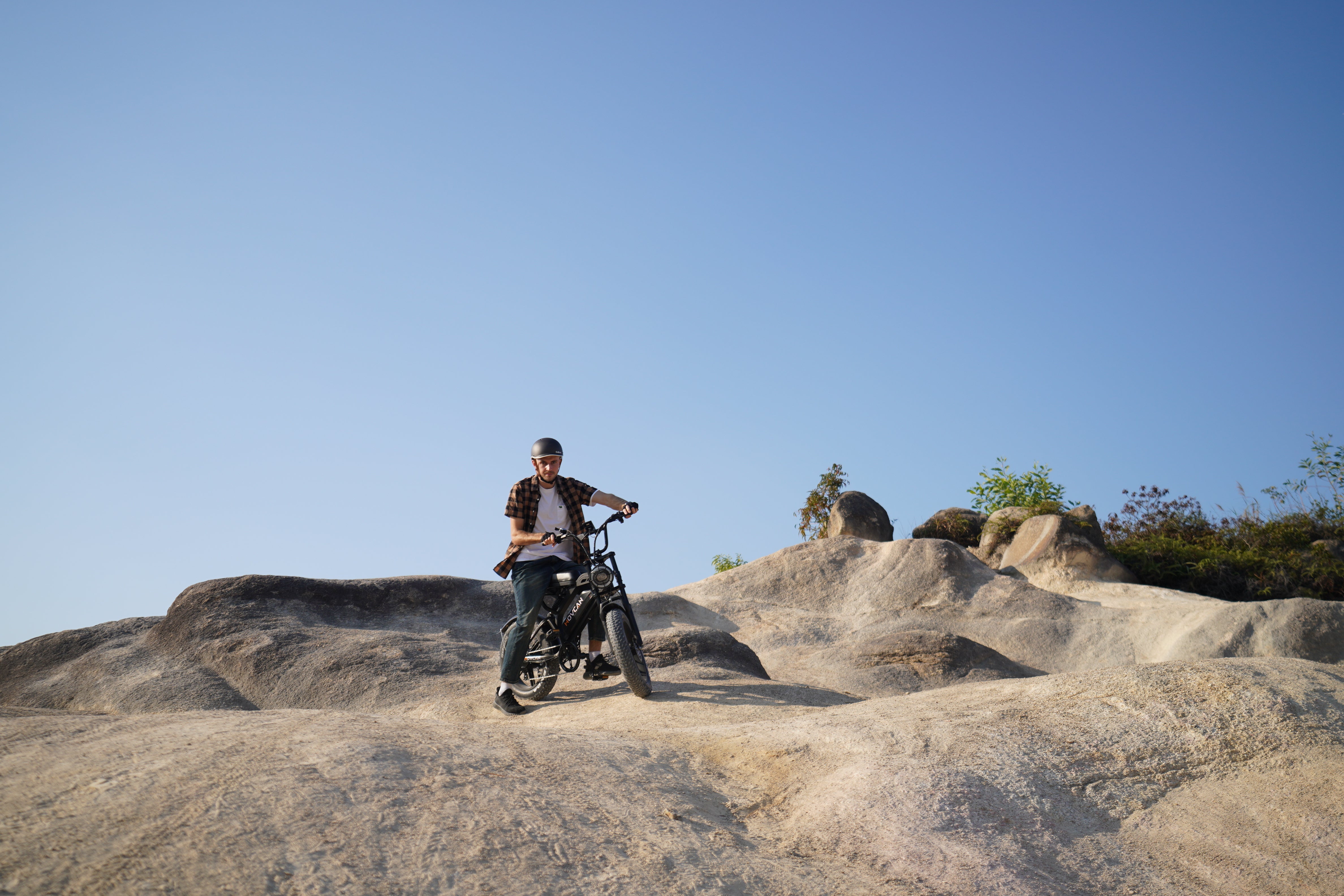
If you've ever finished a ride and wondered why your battery percentage dropped dramatically after a few steep climbs, you're not alone. One of the most common questions among electric bike riders is: "Why does my e-bike battery drain so much faster on hills?"
The answer comes down to simple physics. Terrain is one of the biggest factors affecting e-bike range, often having a greater impact than rider weight, weather conditions, or even riding speed. In this guide, we'll explain why hills consume more energy, compare real-world performance between the Movcan V30 Pro Max and V70, and share practical strategies to extend your range.
Why Hill Climbing Consumes More Battery

On flat roads, your motor primarily fights wind resistance and mechanical friction. When climbing, it must also overcome gravity. Every pound of rider and bike weight must be lifted upward, requiring significantly more torque. This increased demand causes:
-
Higher current draw from the battery.
-
Increased motor temperatures.
-
Faster battery depletion.
Understanding Hill Grades
|
Grade |
What It Feels Like |
|
0–2% |
Flat pavement or bike path |
|
3% |
Gentle neighborhood hill |
|
5% |
Typical suburban climb |
|
8–10% |
Challenging urban hill |
|
12–15% |
Very steep residential road |
|
35°–40° |
Extreme off-road technical climbing |
Real-World Performance: Movcan V30 Pro Max vs. V70
We conducted factory testing under identical conditions (175 lb rider, PAS Level 3) to see how terrain impacts these two powerhouses.
|
Terrain Type |
V30 Pro Max (Dual Motor) |
V70 (Single Motor) |
|
Flat Asphalt (0% Grade) |
1.0x (Baseline) |
1.0x (Baseline) |
|
Moderate Slope (3% Grade) |
1.4x Consumption |
1.5x Consumption |
|
Steep Incline (5%+ Grade) |
2.0x Consumption |
2.3x Consumption |
|
Maximum Climbing Capability |
Up to 40° |
Up to 35° |
Which Bike Conquers Your Hills?

-
Looking for ultimate climbing power? The Movcan V30 Pro Max features a dual-motor system specifically engineered to distribute load and dominate steep, technical inclines.
Click here to explore the V30 Pro Max specs and performance

-
Need a nimble, efficient daily commuter? The Movcan V70 provides a high-voltage 52V punch that makes short work of neighborhood hills while keeping the overall bike weight low for easier handling.
Click here to see why riders love the V70’s agility
Pro Riding Strategies
1. The Urban Hilly Commuter
For stop-and-go city riding, use the V30 Pro Max's dual-motor mode to power through intersections. Shift into a lower gear before the hill begins to keep your cadence between 60–80 RPM—this is the "sweet spot" for motor efficiency.
2. The Weekend Trail Explorer
When off-roading, momentum is your friend. Avoid sudden throttle bursts on loose surfaces; instead, use a steady pedal assist level (PAS 3 or 4) to maintain consistent traction.
3. The Efficient Cruiser
On long climbs, remember: Throttle-only riding is the fastest way to drain your battery. Use pedal assist, shift early, and add your own pedaling effort to significantly extend your range.
Frequently Asked Questions
Q: Which Movcan model is better for my hilly neighborhood?
A: If you regularly encounter inclines over 35°, the V30 Pro Max is the superior choice. For mixed-use commuting, the V70 is an excellent, lightweight performer.
Q: Does climbing hills damage the motor?
A: Not if used correctly. If the bike stalls on an extreme incline, please pedal or dismount to prevent heat build-up in the controller.
Q: What if the motor overheats?
A: If you feel a sudden power drop, the thermal protection system is likely active. Turn off the bike, wait 5–10 minutes, and ensure your battery is above 20% charge.