

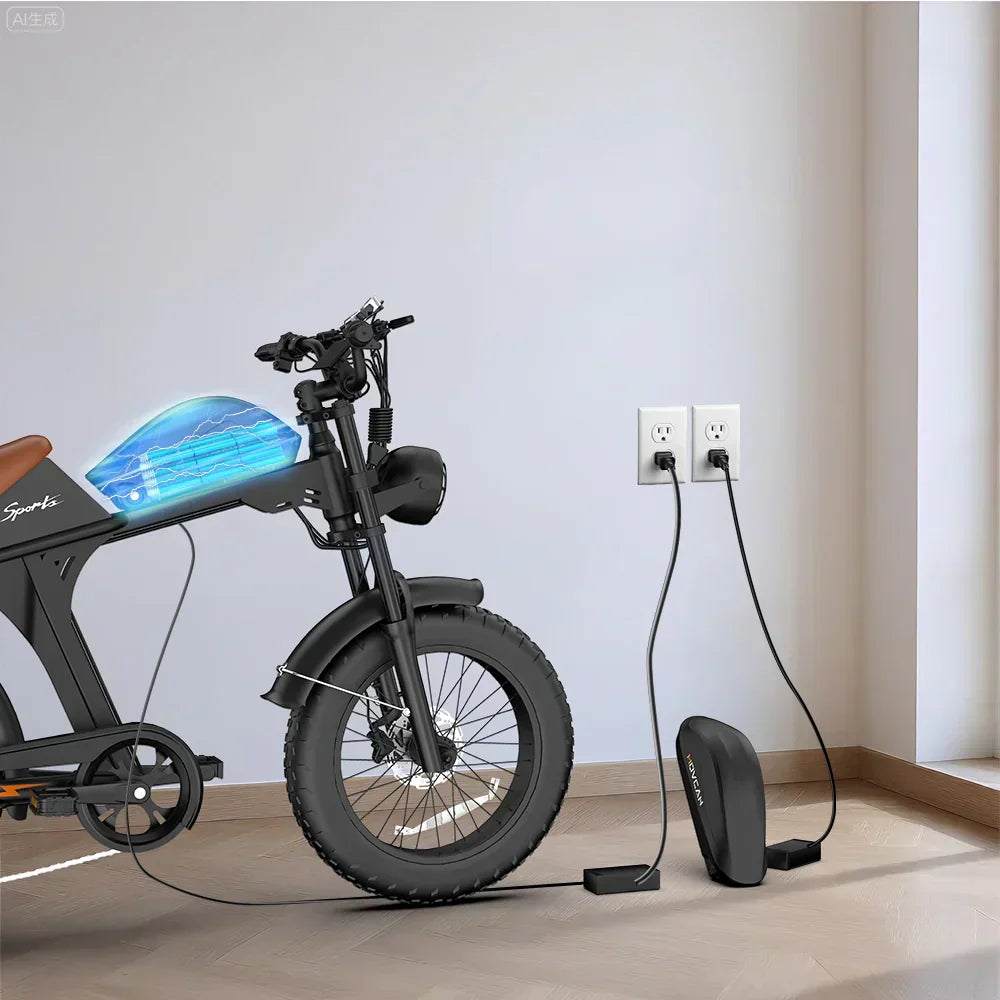
Curious about how far your electric bike can really take you? While every rider’s experience is unique, your real-world range is determined by a handful of key factors. From battery capacity to the hills you tackle daily, knowing what affects your range is the first step to becoming a master of your ride.
Let’s break down these factors and see how the Movcan lineup—from the dual-motor V30 Pro Max to the agile V70—handles the road.
Factor 1: The Heart of the Ride—Battery System

Think of your battery as your fuel tank. Its capacity (in Amp-hours or Watt-hours) is the primary driver of how far you can go. But it’s not just about size; it’s about system efficiency.
For riders who demand absolute endurance, the Movcan V30 Pro Max features a cutting-edge dual-battery system. This setup doesn't just increase your total range to up to 120 miles (PAS); it allows for smart power distribution, ensuring you don't run dry on long adventures. (Link: Explore the V30 Pro Max Dual-Battery System)
Factor 2: Rider Weight & Riding Habits
Physics doesn’t lie. The total load (rider + cargo) directly impacts energy consumption. However, your technique matters even more. Rapid acceleration and "lead-foot" throttle usage are range killers.
The Movcan V70 is built for efficiency. Its 52V high-voltage system allows for punchy, responsive riding without needing to pin the throttle to the max. By maintaining a consistent pace and using pedal-assist to bridge the gap, you’ll find that "real-world" range often exceeds the baseline.
Factor 3: Assist Level & Motor Output

Your PAS settings are the remote control for your battery life.
-
PAS 1–2: Your "Eco" mode for maximizing distance.
-
PAS 5: Your "Boost" mode for conquering steep terrain.
Both the V30 Pro Max and V70 are equipped with intuitive cadence sensors that help you get the most out of every watt. If you’re planning a 50-mile journey, sticking to mid-level assist is the simplest way to ensure you make it home with power to spare.
Factor 4: Terrain & The "Incline Penalty"

Where you ride changes everything. Flat asphalt is the baseline, but loose gravel, sand, and steep inclines significantly increase rolling resistance.
The V30 Pro Max shines here. With its 40° max incline capability and dual-motor torque, it handles the "terrain penalty" better than almost any single-motor bike in its class. When you face a climb, the dual-motor system does the heavy lifting, preventing the rapid voltage sag common in single-motor commuters.
Factor 5: Temperature & Battery Care

Lithium batteries are sensitive. They perform best in moderate climates. Extreme cold can temporarily limit capacity, while heat can accelerate degradation.
All Movcan batteries are designed to be removable, meaning you can bring them inside. Storing your battery indoors is the single most effective way to extend its lifespan and ensure a full-capacity start every time you ride.
Wind Resistance and Riding Speed
Wind resistance is one of the most overlooked factors affecting e-bike range. At higher speeds, aerodynamic drag increases significantly, forcing the motor to work harder and consume more energy.
A strong headwind can reduce your range by 10%–30%, especially when riding above 20 mph. This effect becomes even more noticeable when using throttle-only mode.
To maximize range:
-
Maintain a steady cruising speed instead of frequent acceleration.
-
Use pedal assist rather than relying solely on the throttle.
-
Reduce speed slightly when riding into strong headwinds.
-
Keep your riding posture as streamlined as possible.
For commuters and recreational riders alike, managing speed is often one of the easiest ways to extend battery life without sacrificing comfort.2
Real-World Range vs Advertised Range
Many riders wonder why their actual range doesn't always match the manufacturer's advertised numbers. The answer is simple: range estimates are typically measured under ideal testing conditions.
Factors such as rider weight, terrain, weather, tire pressure, assist level, and riding style all influence real-world performance.
As a general guideline:
|
Riding Condition |
Expected Range |
|
Ideal Conditions |
90–100% of rated range |
|
Normal Daily Riding |
70–90% of rated range |
|
Frequent Hills & Wind |
60–80% of rated range |
|
Heavy Throttle Use |
50–70% of rated range |
For example, an e-bike rated for 100 miles may realistically deliver anywhere from 70 to 90 miles during everyday use, depending on riding conditions.
This is why choosing an e-bike with extra range capacity is always recommended if you regularly ride long distances.
Quick Reference: What Affects E-Bike Range Most?
|
Factor |
Impact on Range |
Tips to Improve Efficiency |
|
Battery Capacity |
Very High |
Choose a larger Ah or Wh battery |
|
Rider Weight |
Medium |
Reduce unnecessary cargo |
|
PAS Level |
Very High |
Ride in PAS 1–3 whenever possible |
|
Terrain |
Very High |
Avoid steep climbs when practical |
|
Wind Resistance |
Medium–High |
Reduce speed into headwinds |
|
Tire Pressure |
Medium |
Keep tires properly inflated |
|
Temperature |
Medium |
Store batteries indoors |
|
Riding Style |
High |
Accelerate smoothly and consistently |
Which Movcan E-Bike Is Right for Your Range Needs?
Different riders have different priorities. Whether you're commuting, exploring trails, or tackling steep hills, choosing the right e-bike can make a significant difference in real-world range.
|
Model |
Best For |
Motor System |
Maximum Range* |
|
Movcan V30 Pro Max |
Long-distance adventures and steep terrain |
Dual Motor |
Up to 120 Miles PAS |
|
Movcan V70 |
Daily commuting and urban riding |
52V High-Efficiency System |
Long-range city riding |
*Actual range varies based on riding conditions, rider weight, terrain, weather, and assist level.
Explore the Movcan lineup and choose the model that best matches your riding style and range expectations.
FAQ: Frequently Asked Questions
Does riding with the throttle only reduce range?
Yes. Throttle-only riding typically consumes significantly more battery power than pedal assist because the motor is doing all the work. Many riders experience 30%–50% less range when using throttle exclusively.
What PAS level provides the best range?
PAS 1–2 generally offers the greatest battery efficiency while still providing noticeable assistance. Higher PAS levels deliver more power but consume energy more quickly.
Are manufacturer range estimates accurate?
Manufacturer estimates are usually measured under controlled conditions, including moderate temperatures, flat terrain, lighter riders, and lower assist levels. Real-world results may vary.
Do fat tire e-bikes have shorter range?
Fat tires create more rolling resistance than standard commuter tires, which can slightly reduce efficiency. However, proper tire pressure and efficient riding habits can minimize the difference.
Does cold weather affect e-bike range?
Yes. Lithium-ion batteries temporarily lose efficiency in cold weather conditions . Depending on conditions, riders may experience a 10%–30% reduction in available range during winter.
How often should I check tire pressure?
Checking tire pressure before long rides and at least once per week helps reduce rolling resistance and improve battery efficiency.
Can carrying cargo reduce range?
Yes. Additional weight requires more energy to accelerate and climb hills. Heavier loads generally reduce total range.
How can I maximize my e-bike's battery life?
Store the battery indoors, avoid extreme temperatures, keep it partially charged during long-term storage, and follow the manufacturer's charging recommendations.
E-bike Range Resource Center
Want to learn more about optimizing your ride? Check out our complete guides: