

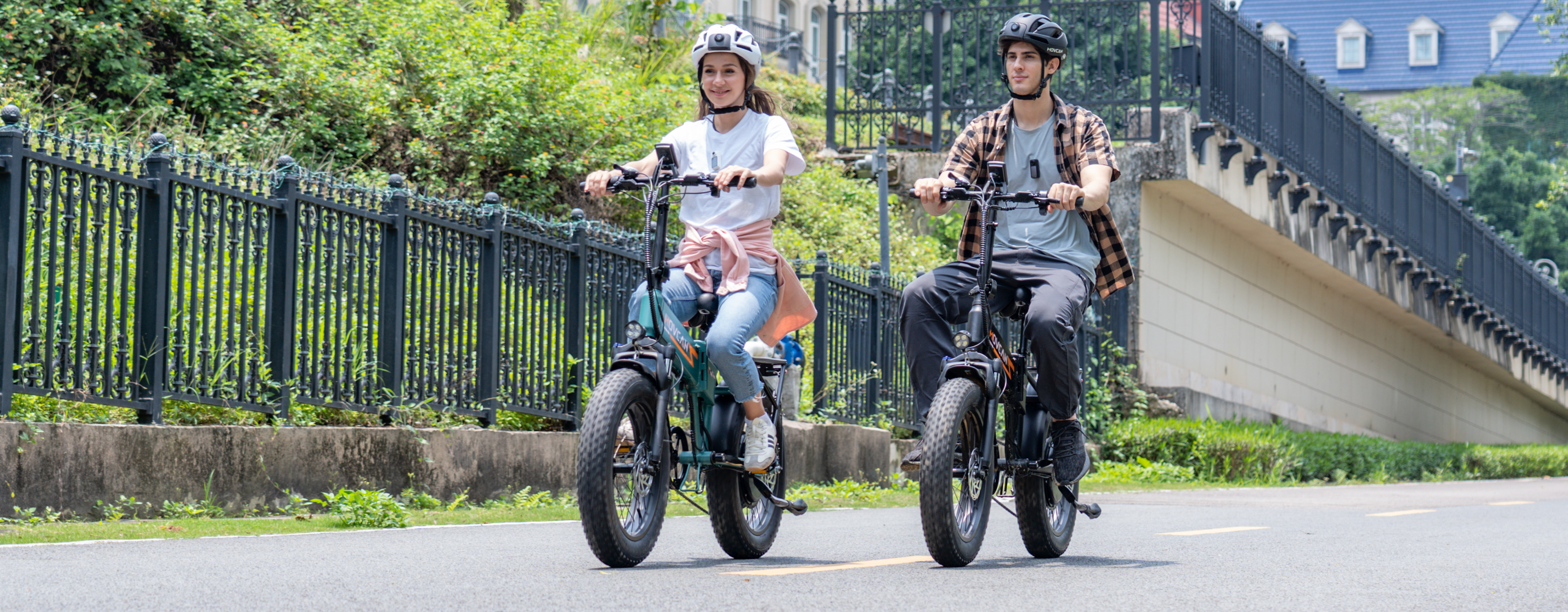
Many electric bike riders notice the same thing after a few rides:
the faster they ride, the faster the battery seems to drop.
At first, it feels unexpected—especially on high-performance e-bikes that promise strong acceleration and long-range capability.
But this is actually a common experience among riders of fast electric bikes, particularly models designed for higher speeds, stronger motors, and aggressive throttle response.
Unlike traditional commuting e-bikes, performance-focused models are affected by far more variables than just battery size. Motor power, riding speed, terrain, rider weight, throttle usage, and even tire pressure all play a major role in real-world energy consumption.
This effect becomes even more noticeable on high-power electric bikes built for speed rather than efficiency.
So why do fast e-bikes drain battery so quickly?
The answer comes down to physics, power demand, and one factor that is often underestimated: speed itself.
Speed Is the Biggest Battery Killer

The faster an e-bike moves, the harder the motor must work to overcome air resistance.
At lower speeds, battery usage increases relatively gradually. But once an e-bike starts pushing above 28–30 MPH, aerodynamic drag rises dramatically.
The relationship looks like this:
Fd=1/2ρCdAv²
In simple terms, air resistance increases exponentially as speed rises.
That means riding at 37.5 MPH requires significantly more energy than cruising at 20–25 MPH, even if both bikes use similar battery systems.
This is one reason high-speed electric bikes often experience much faster battery drain during throttle-heavy riding.
A rider cruising steadily at moderate PAS levels may achieve close to the advertised range estimate. However, riders using full throttle at maximum speed will usually consume battery power far more quickly.
More Power Always Comes With a Tradeoff
High-performance e-bikes are designed to deliver stronger acceleration, higher climbing capability, and more aggressive riding performance.
But that extra performance requires more energy.
The difference becomes easy to understand when comparing electric bikes with different motor configurations.
| Model | Battery Capacity | Peak Power | Top Speed |
|---|---|---|---|
| Movcan V30 Max | 1498Wh Dual Battery | 2000W Peak | 32 MPH |
| Movcan V30ProMax | 1920Wh Dual Battery | 3000W Peak | 37.5 MPH |
At first glance, many riders assume the larger 1920Wh battery on the V30ProMax should automatically deliver dramatically longer range.
However, the V30ProMax also produces substantially more power through its dual-motor drivetrain and higher sustained speeds.
The result is simple:
the bike stores more energy, but it also consumes more energy.
This is the natural tradeoff of performance-focused electric bikes.
The V30 Max is tuned to balance speed, efficiency, and long-distance riding. Meanwhile, the V30ProMax is designed for riders who prioritize acceleration, hill-climbing capability, off-road traction, and higher top speed electric bike.
That extra performance naturally increases battery consumption, especially during aggressive riding.
Dual Motors Consume More Energy
Single-motor and dual-motor e-bikes behave very differently in real-world riding.
A single motor typically consumes less energy during cruising because only one system is delivering torque.
A dual-motor setup, however, can dramatically increase power output, acceleration, and traction. This is especially noticeable during:
- steep hill climbs
- loose terrain riding
- sand or gravel riding
- rapid acceleration from stops
- high-speed riding above 30 MPH
The tradeoff is increased energy consumption.
Dual motors can pull significantly higher current from the battery during acceleration, especially when both motors engage simultaneously under heavy throttle.
This is why many dual-motor electric bikes feel dramatically faster while also draining battery more quickly during aggressive riding sessions.
For riders who prioritize performance, the tradeoff is often completely worth it. The riding experience becomes much more powerful and responsive.
But it is important to understand that high performance always requires higher energy output.

V30 MAX – Dual 48V 15.6Ah Battery – Long Range Power
Why Watt-Hours (Wh) Matter More Than Ah
Many riders compare e-bike batteries only by Ah (amp-hours).
But Ah alone does not tell the full story.
The true energy capacity of an e-bike battery is measured in watt-hours (Wh).
The formula looks like this:
Wh = V × Ah
For example:
Movcan V30 Max: 48 × 31.2 = 1497.6 Wh Approximately 1498Wh total capacity.
Movcan V30ProMax: 48 × 40 = 1920 Wh 1920Wh total capacity.
This means the V30ProMax does carry significantly more stored energy.
However, battery size alone does not determine final range.
A high-output dual-motor drivetrain consuming 3000W peak power can drain energy much faster than a lower-output single-motor system, especially during high-speed riding or repeated acceleration.
This is why two e-bikes with large batteries can still produce very different real-world range results.

V30 PRO MAX – Dual Motor Electric Bike – Up to 37.5 MPH
Hard Acceleration Drains Batteries Faster Than Cruising
One of the biggest causes of battery drain is repeated hard acceleration.
Every time an e-bike launches aggressively from a stop, the controller demands a large burst of current from the battery.
This creates much higher short-term power consumption than smooth cruising.
In city riding, this effect becomes even more noticeable because riders constantly:
- stop at intersections
- accelerate from traffic lights
- use throttle bursts
- brake and restart repeatedly
Aggressive riding styles can reduce real-world range far more than many riders expect.
In contrast, smooth throttle control and steady pedaling assistance can dramatically improve overall efficiency.
This is why two riders using the exact same bike may experience completely different range results.
Fat Tires Also Reduce Efficiency
Fat tire electric bikes provide major advantages in comfort, traction, and stability.
They perform extremely well on:
- gravel
- sand
- snow
- uneven pavement
- off-road terrain
However, fat tires also create additional rolling resistance.
Wider tires generate more surface contact with the ground, which requires more energy to maintain speed.
Low tire pressure can make this even worse.
Underinflated fat tires create noticeable drag and can reduce battery efficiency significantly during long rides.
For riders focused on maximizing range, maintaining proper tire PSI is extremely important.
Real-World Riding Conditions Matter More Than Advertised Numbers
Many advertised range estimates are achieved under ideal test conditions.
This often includes:
- low PAS levels
- lighter riders
- flat terrain
- minimal wind resistance
- moderate speeds
- very limited throttle usage
Real-world riding is usually much more demanding.
Factors that heavily affect battery consumption include:
| Riding Condition | Battery Impact |
|---|---|
| Riding above 30 MPH | Very High |
| Dual motor usage | Very High |
| Full throttle acceleration | Very High |
| Steep hills | High |
| Heavy rider or cargo weight | Medium-High |
| Low tire pressure | Medium |
| Cold weather | Medium |
This is why real-world range can vary dramatically depending on riding style and terrain.
How to Increase E-Bike Range Without Sacrificing Performance
High-performance e-bikes can still achieve excellent range when ridden efficiently.
A few simple habits can make a major difference:
Use lower PAS levels during cruising
Higher PAS settings consume more power continuously.
Accelerate smoothly
Avoid repeated full-throttle launches whenever possible.
Maintain proper tire pressure
Correct PSI reduces rolling resistance significantly.
Reduce unnecessary high-speed riding
Cruising at 25 MPH is far more efficient than maintaining 37 MPH continuously.
Use pedal assist instead of throttle-only riding
Even moderate pedaling can noticeably reduce battery drain.
Ride in the most efficient motor mode
If the bike supports adjustable power modes, lower-output settings can dramatically improve range.
Final Thoughts
Fast electric bikes drain battery more quickly for one simple reason:
performance requires energy.
Higher top speeds, dual motors, aggressive acceleration, and off-road capability all increase battery consumption dramatically compared to lower-power commuter e-bikes.
That does not mean high-performance e-bikes are inefficient.
It simply means they are engineered for a different riding experience.
The Movcan V30 Max focuses on balancing power and long-distance usability, while the V30ProMax pushes much further toward maximum acceleration, climbing capability, and high-speed riding performance.
For many riders, that extra power is absolutely worth the tradeoff.
The key is understanding how speed, motor output, and riding style affect real-world battery performance before choosing the e-bike that best matches your riding goals.
FAQ
Why do fast e-bikes drain battery faster?
Fast e-bikes consume more energy because higher speeds create significantly more air resistance and require greater motor output.
Do dual motors reduce e-bike range?
Dual motor electric bikes can reduce range during aggressive riding because they consume more power, especially during acceleration and hill climbing.
Is a bigger Ah battery always better?
Not necessarily. Watt-hours (Wh) provide a more accurate measurement of total battery energy than Ah alone.
What affects e-bike range the most?
Speed, throttle usage, motor power, hills, rider weight, and tire pressure all strongly affect battery range.
Can riding slower improve e-bike range?
Yes. Riding at moderate speeds and using smoother acceleration can significantly increase real-world range.