

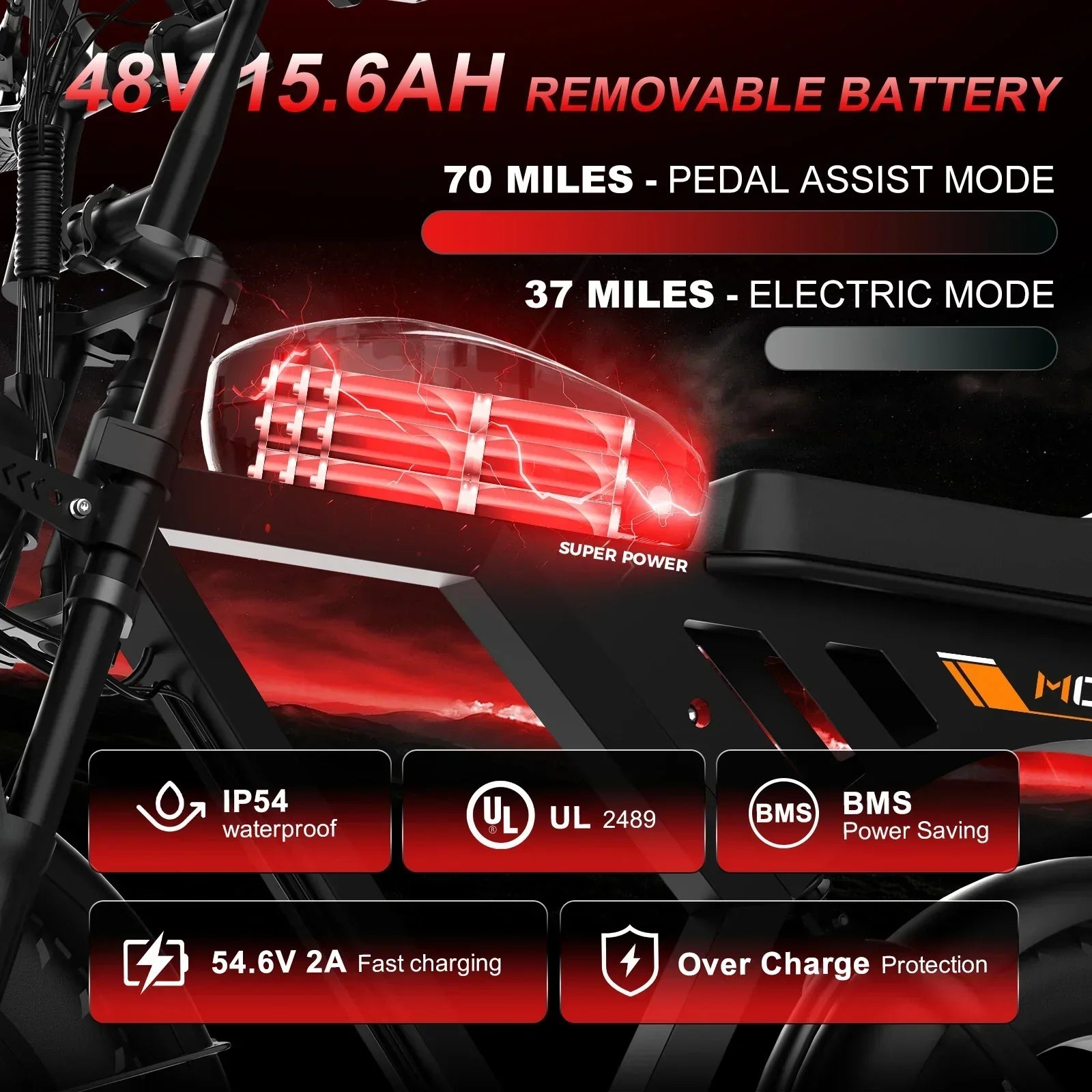
If you're new to the world of electric bikes, you’ve probably stared at your charger and wondered: "Can you overcharge an e-bike battery?"
Here is the short, reassuring answer:
Modern e-bike batteries are engineered to prevent true overcharging. However, leaving them plugged in for days or weeks at a time is still a bad habit that can silently kill your battery's lifespan.
Whether you ride a commuter e-bike or a heavy-duty fat tire cruiser, almost all modern electric bikes rely on Lithium-ion (Li-ion) technology. While these batteries are smarter than ever, knowing how to care for them will save you hundreds of dollars in premature replacements.
How Modern E-Bike Batteries Protect Themselves

Most modern fat tire electric bikes and commuter electric bikes sold in the United States use lithium-ion battery packs paired with a smart charger and a built-in Battery Management System (BMS).
Think of the BMS as the brain of your battery. It constantly monitors the health of the pack and performs several critical safety functions:
-
Automatic Shutoff: It cuts off the current the exact moment the battery hits 100%.
-
Voltage Regulation: It prevents dangerous voltage spikes.
-
Thermal Protection: It stops charging if the battery gets too hot.
-
Cell Balancing: It ensures all individual internal cells age at the same rate.
The Bottom Line: If you accidentally leave your e-bike plugged in overnight, you won’t wake up to a destroyed battery. The charger will simply switch to a passive standby mode.
Overcharging vs. High-Voltage Stress: The Real Danger
If the BMS stops the charging process, what’s the issue with leaving it plugged in? It comes down to a crucial distinction:
-
Overcharging (Forcing energy into a full battery): Prevented by the BMS.
-
High-Voltage Stress (Keeping a battery at 100%): Cannot be prevented by the BMS.
Lithium-ion batteries are happiest when they are operating between 20% and 80% capacity. When a battery sits at 100% for consecutive days or weeks, it experiences prolonged chemical stress. Over time, this stress degrades the internal components, permanently shrinking your maximum riding range.
Is It Safe to Charge an E-Bike Battery Overnight?
Yes, for most typical riders, overnight charging is perfectly safe.
If you plug your bike in at 10 PM, it will likely hit 100% around 2 AM, and sit idle until you unplug it at 7 AM. This brief window of sitting at full charge does negligible damage.
When does it become a problem?
-
Leaving it plugged in over a long weekend.
-
Leaving it connected for weeks during the winter off-season.
-
Forgetting it on the charger in a hot garage.

How Long Should an E-Bike Battery Charge?
Charging times vary widely based on the battery's capacity (measured in Amp-hours or Ah) and the charger’s output. Use this quick reference guide to estimate your charge times:
|
Battery Specs |
Typical Charge Time (0% to 100%) |
Common Bike Type |
|
36V 10Ah |
4 – 5 Hours |
Lightweight Commuters |
|
48V 13Ah |
5 – 6 Hours |
Standard City E-Bikes |
|
48V 15Ah |
6 – 7 Hours |
All-Terrain E-Bikes |
|
48V 20Ah |
7 – 9 Hours |
Long-Range Fat Tire Bikes |
|
52V 20Ah |
8 – 10 Hours |
High-Performance E-Bikes |
Note: Because larger fat-tire e-bike batteries require 8+ hours to charge fully, overnight charging is often both practical and necessary.
5 Pro-Tips to Maximize Your Battery Life
Want your battery to last for years? Implement these five simple habits:
1. Avoid the "Dead Zone"
Try not to run your battery down to 0%. Draining a lithium battery completely puts immense strain on the cells. Aim to plug it in when it drops to around 20–30%.
2. The "Next Morning" Rule
You don’t need to hover over your charger waiting for the light to turn green. Just make it a habit to unplug the charger the next morning rather than letting it sit connected all week.
3. Stick to the OEM Charger
Cheap, third-party chargers from online marketplaces are a leading cause of e-bike battery failures. They can output the wrong voltage or lack the safety protocols needed to communicate with your BMS. Always use the original manufacturer's charger.
If you're considering replacing your battery or charger in the future, it's important to understand compatibility requirements first.
Can You Upgrade an E-Bike Battery?
4. Golden Rules for Winter/Long-Term Storage
If you aren't going to ride for a month or more, do not store the battery at 100% or 0%.
-
Charge or discharge the battery to 50% – 70% (roughly 3 out of 5 bars).
-
Check and top it off slightly every 1–2 months.
-
Store it indoors.
5. Respect the Temperature Range
Extreme temperatures are the enemy of lithium. Never charge a battery that is frozen, and avoid charging in direct sunlight.
-
Ideal Storage Temp: 50°F – 77°F (10°C – 25°C)
Does Charging to 100% Damage the Battery?
No. Charging your bike to 100% right before a long ride is exactly what the battery was designed for. The issue is only when the battery lives at 100% for days without being used.
💡 Pro-Tip from Experienced Riders: If you only have a short daily commute, try charging your battery to 80%–90% during the week. Save the full 100% charge for your long weekend adventures. This subtle shift can add months to your battery's overall lifespan.
The Lifespan: What Can You Expect?
A quality, well-cared-for e-bike battery will generally last:
-
500 to 1,000 full charge cycles
-
3 to 5 years of regular riding
Batteries don't just stop working one day. Battery degradation is also influenced by riding speed, motor output, terrain, and charging frequency.
Instead, they experience a gradual reduction in capacity. For example, an older battery that once gave you a 50-mile range might only give you 38 miles after four years. This degradation is normal, but proper charging habits slow it down significantly.
How Fast Can a 48V E-Bike Really Go?
⚠️ Warning Signs: When to Unplug Immediately
While catastrophic failures are rare with certified batteries, you should immediately disconnect your charger and contact the manufacturer if you experience:
-
The battery pack feels hot to the touch (not just warm) while charging.
-
Any physical swelling, bloating, or deformation of the plastic casing.
-
A strange, sweet, or burning chemical odor.
-
The charger stays red and fails to cut off after the expected charging time.
Final Verdict
Can you overcharge a modern e-bike battery? Technically, no. Your BMS has you covered.
However, practicing good battery hygiene—like unplugging it when it's full, storing it at a partial charge, and using the right equipment—will keep your electric bike running stronger, farther, and safer for years to come.
FAQ
Can I leave my e-bike plugged in all night?
Yes. Smart chargers and built-in BMS protections make overnight charging completely safe for standard use.
Can overcharging cause an e-bike fire?
With a certified battery, functioning BMS, and original charger, the risk is incredibly low. Most reported e-bike fires are caused by physical damage to the pack, aftermarket chargers, or uncertified DIY battery modifications.
Should I charge my e-bike after every single ride?
Not if it was a short trip. If you only used 10% of the battery, there is no need to top it off. Wait until it drops below 80%, or down to about 30% for ideal health.
Daily commuters often develop different charging habits compared with riders using their bikes for weekend adventures.
What happens if I leave my e-bike plugged in for a week straight?
While it won't explode or overcharge, it will remain under high-voltage stress. Doing this repeatedly will prematurely age the battery and reduce your maximum riding range over time.