

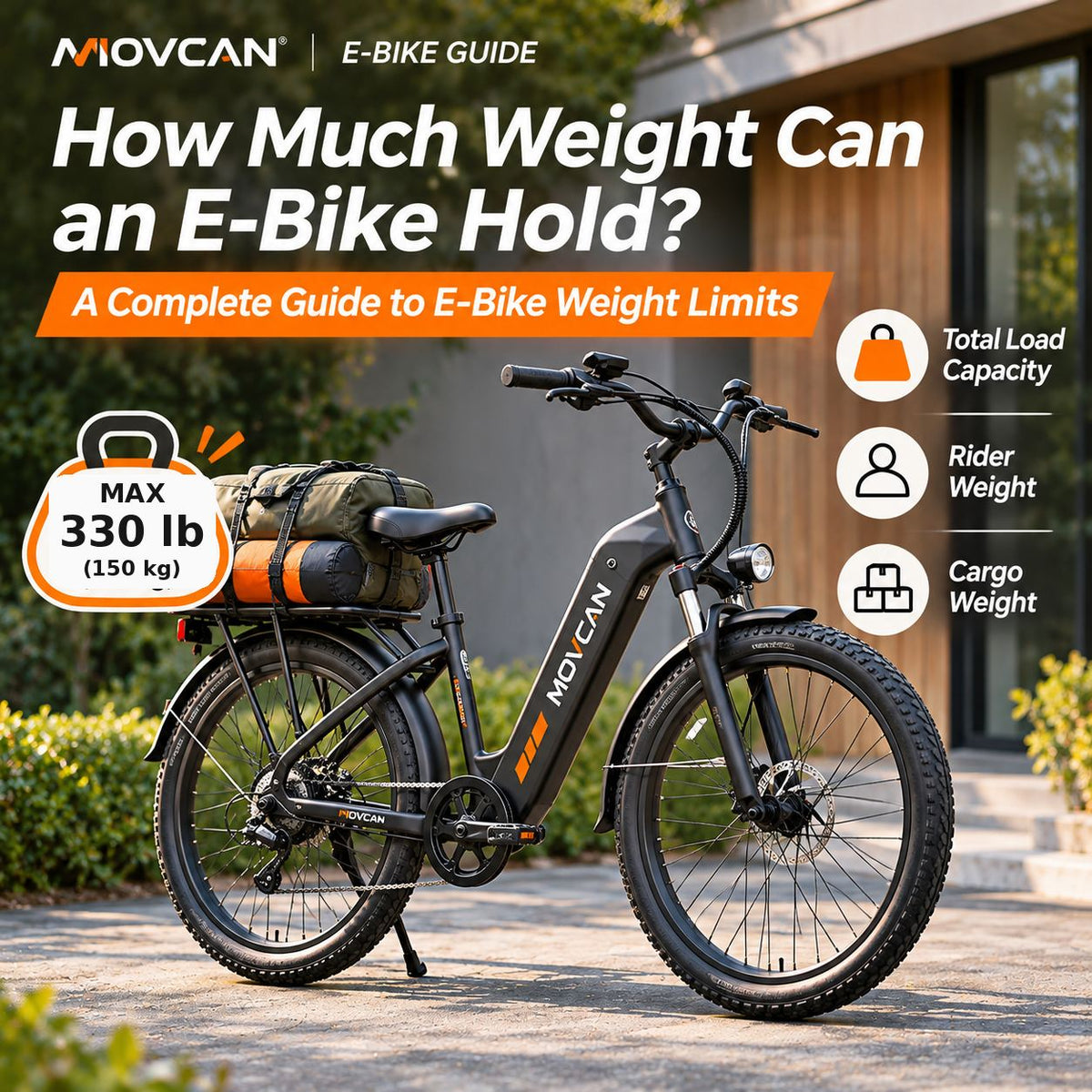
If you're considering buying an electric bike, one of the most important questions is: how much weight can an e-bike hold?
Whether you're a heavier rider, carrying groceries, commuting with equipment, or planning longer outdoor adventures, understanding an electric bike's weight capacity is essential for safety and performance.
The answer depends on the bike's frame, wheels, tires, brakes, and manufacturer specifications. Some electric bikes are designed for lighter everyday use, while others are built to support greater combined loads.
In this guide, we'll explain typical e-bike weight limits, what counts toward those limits, how rider weight affects performance, and how to choose a suitable electric bike.
How Much Weight Can an Electric Bike Hold?
Many adult electric bikes have maximum load ratings in the range of approximately 250 to 350 pounds, although actual capacities vary considerably by model.
Some lightweight electric bikes have lower limits, while certain purpose-built cargo bikes support substantially more weight.
The most important number is not the average capacity of electric bikes in general. It is the manufacturer's published limit for the exact model you plan to ride.
For example, several models in the Movcan electric bike collection list a maximum capacity of 330 pounds.
This makes it possible for riders to compare options using a clearly stated load rating rather than relying on motor wattage or frame appearance.
However, it's important to understand what that capacity actually means.
What Does E-Bike Weight Capacity Mean?
Electric bike weight capacity usually refers to the maximum load the bike is designed to carry.
Depending on the manufacturer's terminology, this may include the rider, clothing, accessories, luggage, and any other items carried on the bike.
It is important to distinguish between two specifications.
Maximum Payload Capacity
Payload capacity generally refers to the weight carried by the bike, excluding the bicycle itself.
For example, if an electric bike has a confirmed payload limit of 330 pounds, the combined weight of the rider and permitted cargo must remain within that limit.
Maximum Gross Vehicle Weight
Some manufacturers specify a maximum gross weight that includes the bicycle itself, rider, cargo, and accessories.
This is not the same as payload capacity.
If the published specification is unclear, consult the owner's manual or contact the manufacturer before calculating how much cargo you can safely carry.
Never assume that a listed maximum weight refers only to the rider.
How to Calculate Your E-Bike's Total Load
To determine whether your electric bike can safely accommodate your needs, add up the weight of everything the bike will carry.
For example:
| Item | Weight |
|---|---|
| Rider | 250 lbs |
| Backpack | 15 lbs |
| Groceries | 20 lbs |
| Additional accessories | 5 lbs |
| Total carried load | 290 lbs |
If the bike's confirmed payload capacity is 330 pounds, this example leaves 40 pounds of unused payload capacity.
That does not mean every rack, basket, or attachment can carry the remaining weight.
Individual accessories often have their own lower weight limits, which must also be respected.
A rear rack rated for 25 pounds cannot safely carry 40 pounds simply because the bicycle has unused overall payload capacity.
What Determines How Much Weight an E-Bike Can Hold?
Several components influence an electric bike's load-carrying capability.
1. Frame Construction
The frame provides the structural foundation of the bicycle.
Its material, geometry, joints, and overall engineering influence how it handles rider and cargo loads.
However, frame material alone does not establish the weight limit.
An aluminum frame is not automatically weaker or stronger than a steel frame. The complete design and manufacturer's testing determine the appropriate rating.
2. Wheels and Tires
Wheels and tires play an important role in supporting weight.
Spokes, rims, hubs, tire construction, and inflation pressure all contribute to load handling.
Fat-tire electric bikes may offer a wider contact patch and improved traction on certain surfaces, but wider tires do not automatically mean a higher weight capacity.
The complete bicycle must be rated for the intended load.
3. Braking System
Heavier loads require more braking force and can increase stopping distances.
Brake design, rotor size, pad condition, tire grip, terrain, and speed all influence stopping performance.
Riders carrying substantial weight should pay particular attention to brake maintenance.
4. Suspension System
Suspension can improve comfort when riding over uneven surfaces.
However, suspension components must be suitable for the rider's weight and intended use.
Incorrect suspension settings may cause excessive sag, bottoming out, or poor handling.
A bike's overall weight limit still applies even when its suspension can be adjusted.
5. Motor and Battery System
A motor does not directly determine the structural weight capacity of an electric bike.
However, motor torque and electrical performance influence how the bike accelerates and climbs when carrying a heavier load.
Battery capacity also affects how far the bike can travel before recharging.
A powerful motor cannot compensate for an overloaded frame, wheel, or braking system.
How Much Weight Can a Movcan Electric Bike Hold?
Movcan offers several adult electric bikes with published capacities of 330 pounds.
According to Movcan's official collection listings, the following models are rated at 330 pounds.
| Movcan Model | Listed Weight Capacity | Main Riding Style |
|---|---|---|
| Movcan V30 | 330 lbs | Fat-tire everyday riding |
| Movcan V30 Max | 330 lbs | Dual-battery riding |
| Movcan V30 Pro Max | 330 lbs | Dual-motor performance |
| Movcan V60 | 330 lbs | Fat-tire commuting and recreation |
| Movcan V60 Pro | 330 lbs | Higher-performance fat-tire riding |
| Movcan V70 | 330 lbs | Performance-focused riding |
| Movcan V80 | 330 lbs | Urban commuting |
| Movcan Q20 | 330 lbs | Folding electric bike |
| Movcan EB60 | 330 lbs | Fat-tire off-road riding |
These figures reflect published product listings. Always confirm the latest capacity and load definition for your exact bike configuration before riding.
Movcan V60: An Option for Everyday Riding
The Movcan V60 combines fat tires with an electric assistance system designed for commuting and recreational use.
Its published 330-pound capacity makes it an option worth considering for riders who need a clearly stated load limit.
Its 20 x 4.0-inch tires are intended to provide traction across a variety of riding surfaces.
As with any electric bike, the maximum capacity should not be exceeded, and cargo should be secured appropriately.
Movcan V30 Pro Max: Dual-Motor Performance
The Movcan V30 Pro Max features a dual-motor configuration and dual batteries.
Movcan lists a combined peak motor power of 3,000 watts and a weight capacity of 330 pounds.
The additional motor performance may be useful for demanding riding conditions, but it does not increase the published maximum load beyond 330 pounds.
This distinction is important: motor output and safe weight capacity are separate specifications.
Movcan V80: A Commuting-Focused Option
For riders who prioritize city travel, the Movcan V80 offers a different configuration from the brand's fat-tire models.
Movcan lists a 330-pound capacity and a 26 x 1.95-inch tire size for this commuter-oriented electric bike.
Choosing between the V80 and a fat-tire model should depend on riding conditions, comfort, handling preferences, and the exact load requirements.
Can a 300-Pound Person Ride an Electric Bike?
Yes. A person weighing 300 pounds can ride an electric bike if the bicycle is specifically rated to accommodate the complete intended load.
For a model with a confirmed 330-pound payload capacity, a 300-pound rider would have approximately 30 pounds remaining for clothing, bags, and other carried items.
This calculation assumes the 330-pound figure is a payload rating rather than a gross vehicle weight rating.
Before purchasing, verify the manufacturer's terminology and account for everything you plan to carry.
Riders near a bike's maximum weight capacity should also consider:
- Frame and wheel durability
- Brake performance
- Tire load ratings
- Comfortable riding position
- Suspension suitability
- Expected terrain
- Available payload for cargo
The goal is not simply to find a bike that can move under your weight. It is to find one that can safely and comfortably handle your complete riding needs.
Can an E-Bike Hold 350 or 400 Pounds?
Some electric bikes are specifically designed for higher loads and may accommodate 350 or 400 pounds or more.
However, these capacities should never be assumed.
If you weigh 350 pounds, a bicycle rated for 330 pounds is not an appropriate choice, even if it has a powerful motor or heavy-duty appearance.
Similarly, a 400-pound rider should look for a bicycle with a manufacturer-confirmed capacity that accommodates the rider and all additional carried items.
Purpose-built cargo bicycles and heavy-duty electric bikes may offer higher limits, but their specifications must be checked individually.
What Happens If You Exceed an E-Bike's Weight Limit?
Exceeding the manufacturer's maximum load rating can create several risks.
Reduced Braking Performance
A heavier combined load increases the amount of energy the brakes must manage.
Stopping distances may increase, particularly on steep descents or slippery roads.
Greater Stress on Wheels and Tires
Overloading can place excessive stress on spokes, rims, hubs, and tires.
This may increase the risk of wheel damage or tire failure.
Increased Frame and Component Stress
A bicycle's frame and components are designed for specified operating loads.
Repeatedly exceeding those limits can accelerate wear and potentially contribute to structural failure.
Reduced Battery Range
Heavier loads generally require more energy during acceleration and climbing.
As a result, riders may experience shorter battery range compared with lighter-load conditions.
Poorer Handling
Excessive or poorly distributed weight can affect steering, balance, cornering, and stability.
Cargo placed high above the rear wheel may be particularly noticeable during turns.
For these reasons, a manufacturer's weight limit should be treated as a safety specification, not a performance target to exceed.
Does Rider Weight Affect E-Bike Battery Range?
Yes. Rider weight is one of several factors that influence how much energy an electric bike consumes.
A heavier combined load generally increases the energy required for acceleration and uphill travel.
However, the exact effect depends on terrain, wind, tire pressure, speed, assistance level, and riding style.
On a flat route at a steady speed, the difference may be less noticeable than on a hilly route with frequent stops.
For example, a rider carrying an additional 40 pounds may experience a larger reduction in range on steep hills than during relaxed riding on level pavement.
Manufacturer-advertised maximum range figures are usually obtained under particular test conditions.
Real-world results may differ substantially.
Do Fat-Tire Electric Bikes Have Higher Weight Limits?
Not necessarily.
Fat-tire electric bikes often feature wide tires designed to improve traction and comfort on loose or uneven terrain.
However, tire width alone does not determine maximum payload.
A fat-tire electric bike rated for 330 pounds is not automatically capable of carrying more than a commuter bike with the same published capacity.
Movcan's product lineup illustrates this distinction: both fat-tire models and the commuting-focused V80 have listings showing 330-pound capacity.
The correct choice depends on the complete bicycle design and the terrain you intend to ride.
How to Choose an E-Bike for a Heavier Rider
If you are shopping for an electric bike and need a higher weight capacity, consider the following factors.
Confirm the Exact Weight Rating
Start with the manufacturer's published payload or gross weight specification.
Make sure you understand whether the number includes the bicycle itself.
Leave Room for Cargo
If you weigh 280 pounds and regularly carry 25 pounds of equipment, your intended carried load is already 305 pounds.
Choose a bike that can accommodate that combined load.
Evaluate Riding Comfort
Seat shape, handlebar position, frame geometry, and suspension can influence comfort.
A bicycle that meets your weight requirements may still feel uncomfortable if the riding position is unsuitable.
Consider Your Terrain
Flat urban streets, steep hills, gravel roads, and off-road trails place different demands on the bicycle.
Choose a model designed for your typical riding environment.
Check Brakes and Tires
Pay attention to brake specifications, tire condition, and the manufacturer's inflation recommendations.
Never exceed the tire's stated maximum pressure or load rating.
Review the Manufacturer's Documentation
A published product listing is useful, but the owner's manual may provide additional information about load limits, accessory restrictions, and operating conditions.
Movcan owners can access model documentation through the official Movcan user manual page.
Tips for Riding an E-Bike Safely With a Heavy Load
Once you've chosen a suitable electric bike, a few habits can help maintain safer handling and consistent performance.
First, keep cargo as low and centered as practical, using approved mounting points.
Second, inspect tire pressure before riding and follow the recommended pressure range for your load and tire configuration.
Third, allow more stopping distance when carrying additional weight.
Fourth, accelerate smoothly and use appropriate gearing when climbing hills.
Finally, inspect wheels, brakes, and mounting hardware regularly, especially if you frequently ride near the bicycle's maximum rated capacity.
Frequently Asked Questions
What is the average weight limit for an electric bike?
Many adult electric bikes have load ratings around 250 to 350 pounds, but this is not a universal standard. Always check the exact manufacturer's specification.
Can a 300-pound person ride a Movcan electric bike?
Several Movcan models list a 330-pound capacity. A 300-pound rider may be within that rating if the complete carried load stays within the manufacturer's confirmed limit.
Can an electric bike carry two people?
Only if the manufacturer specifically designs and rates the bike for a passenger. A high total weight capacity alone does not mean an electric bike is approved for two riders.
Does a more powerful motor mean a higher weight capacity?
No. Motor power affects propulsion performance, while weight capacity depends on the complete bicycle design, including its frame, wheels, tires, and brakes.
Can I increase my e-bike's weight capacity by changing the tires?
Changing tires does not increase the manufacturer's approved overall weight capacity. The frame, wheels, brakes, and other components still have their original design limits.
How much cargo can I carry on an electric bike?
Cargo allowance depends on the remaining payload capacity and any separate limits for racks, baskets, or accessories. The lowest applicable limit must be respected.
Does a heavier rider drain an e-bike battery faster?
A heavier total load can increase energy consumption, especially during acceleration and climbing. The actual range difference varies with riding conditions and assistance settings.
Final Thoughts
So, how much weight can an e-bike hold?
For many adult electric bikes, the answer falls somewhere around 250 to 350 pounds, but the correct limit always depends on the specific model.
Several Movcan electric bikes publish a 330-pound capacity, providing options for riders who want to compare clearly stated load ratings across different riding styles.
Before choosing a bike, calculate your complete carried load, verify the manufacturer's capacity definition, and consider the brakes, tires, comfort, and terrain.
The best electric bike is not simply the one with the most powerful motor. It's the one designed to carry your intended load safely while delivering the riding experience you need.