

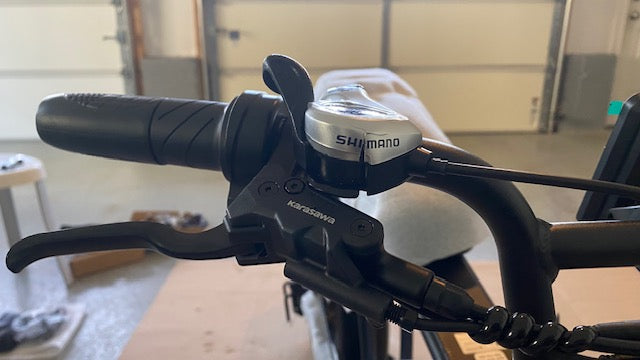
An electric bike throttle gives riders a simple way to activate motor assistance directly from the handlebars. Instead of relying entirely on pedal input, you can use the throttle to help with starts, hills, stop-and-go riding, and other situations where extra motor power is useful.
But how does an eBike throttle actually work?
What happens electrically when you press or twist the throttle? How is that signal converted into motor power? And what should you check when your eBike throttle suddenly stops working?
In this guide, we'll explain how an electric bike throttle works, the most common throttle types, the difference between throttle control and pedal assist, common throttle problems, and practical safety tips for using an eBike throttle.
What Is an Electric Bike Throttle?
An electric bike throttle is a handlebar-mounted control that allows the rider to request motor power without continuously pedaling.
Unlike a Pedal Assist System (PAS), which detects pedal movement and then activates motor assistance, a throttle allows the rider to control motor output directly through a thumb lever or rotating grip.
A simplified version of the process looks like this:
Rider Input → Throttle Signal → Motor Controller → Motor → Wheel
Depending on the eBike and its settings, throttle operation can be especially useful for:
-
Starting from a stop without heavy pedaling
-
Accelerating smoothly in traffic
-
Climbing hills with additional motor assistance
-
Getting through stop-and-go traffic more easily
-
Managing low-speed situations where precise motor control is helpful
For heavier fat tire eBikes or high-powered models, throttle control can be particularly convenient when getting the bike moving from a standstill.
How Does an eBike Throttle Work?
An eBike throttle does not normally send battery power directly to the motor. Instead, it acts as an input device that sends a control signal to the motor controller.
The controller then interprets that signal and determines how much electrical power should be delivered to the motor.
Here's how the process works.
1. You Press or Twist the Throttle
When you activate a thumb throttle or twist throttle, the physical movement changes the throttle's electrical output.
Many modern eBike throttles use a Hall-effect sensor to detect throttle position. A small magnet and sensor work together to determine how far the throttle has been moved.
In simple terms:
Throttle released → Minimum signal
Throttle partially engaged → Higher signal
Throttle fully engaged → Maximum requested signal
The exact signal range varies by manufacturer and controller, so there is no single voltage specification that applies to every eBike.
2. The Throttle Sends a Low-Voltage Signal
The throttle typically connects to the motor controller using a small wiring harness.
A common setup includes three basic connections:
Power → Ground → Signal
The power wire supplies the throttle electronics, the ground completes the circuit, and the signal wire communicates throttle position to the controller.
Many systems use a variable-voltage signal, but the exact voltage range depends on the specific throttle and controller.
This is why replacing an eBike throttle is not always as simple as finding one with the same connector. Wiring, voltage, signal characteristics, and controller compatibility all matter.
3. The Motor Controller Processes the Signal
The motor controller is essentially the control center of the eBike's electrical system.
Once the controller receives the throttle signal, it determines whether motor power should be delivered and how much power is appropriate.
Depending on the eBike system, the controller may also consider information such as:
-
Battery voltage
-
Motor speed
-
Current limits
-
Speed settings
-
Brake cut-off signals
-
System error conditions
-
Motor or controller protection limits
This allows the controller to regulate motor output instead of simply sending maximum battery power every time the throttle is activated.
4. The Motor Converts Electrical Energy Into Motion
Once the controller determines that motor assistance should be provided, it regulates electrical current from the battery to the motor.
The motor then converts that electrical energy into mechanical power.
Hub Motor eBikes
On a hub motor eBike, the motor is integrated into the front or rear wheel hub.
The motor directly rotates the wheel to move the bike forward.
Mid-Drive eBikes
On a mid-drive eBike, the motor is mounted near the crank and transfers power through the bicycle's drivetrain.
This allows the motor to work through the chain, gears, and rear wheel.
What Happens When You Release the eBike Throttle?
When you release the throttle, the throttle signal returns toward its inactive position.
The controller detects that the motor request has decreased and reduces or stops motor output according to the system's programming.
This is why a properly functioning throttle should respond progressively when you accelerate and release it.
Many eBikes also include brake motor cut-off sensors. When a brake lever is activated, the controller can immediately disable motor assistance even if the throttle is still being held.
Types of Electric Bike Throttles
There are three common eBike throttle designs: thumb throttles, half-twist throttles, and full-twist throttles.
Thumb Throttle
A thumb throttle uses a small lever operated with your thumb.
Because your palm and other fingers can remain around the handlebar grip, many riders find this design comfortable and easy to control.
Advantages:
-
Easy one-handed operation
-
Good handlebar grip
-
Precise speed adjustment
-
Compact design
Common applications:
-
Commuter eBikes
-
Fat tire eBikes
-
Utility eBikes
-
Off-road eBikes
Half-Twist Throttle
A half-twist throttle rotates only part of the handlebar grip.
Instead of pressing a thumb lever, the rider controls motor output by rotating the grip with their wrist.
Advantages:
-
Smooth throttle control
-
Familiar feel for motorcycle and scooter riders
-
Convenient for longer rides
-
Lower risk of accidentally rotating the entire grip compared with some full-twist designs
Half-twist throttles are common on moped-style and performance-oriented eBikes.
Full-Twist Throttle
A full-twist throttle rotates most or all of the grip, similar to the throttle on a motorcycle or scooter.
This design can feel intuitive to riders who already have experience with motorized two-wheelers.
However, it can also require more attention at low speeds because the entire grip moves when you accelerate.
Throttle vs. Pedal Assist: What's the Difference?
Throttle control and pedal assist both provide motor assistance, but they work in different ways.
|
Feature |
Throttle Control |
Pedal Assist |
|
Activation |
Rider activates throttle |
System detects pedaling |
|
Pedaling Required |
Not necessarily |
Yes |
|
Control Method |
Thumb or twist input |
Cadence or torque sensor |
|
Main Benefit |
Direct motor assistance |
Natural assisted cycling |
|
Typical Use |
Starts, hills, traffic, quick assistance |
Commuting, fitness, longer rides |
Which Is Better?
It depends on how you ride.
A throttle is convenient when you want motor assistance immediately, particularly when starting from a stop or climbing a hill.
Pedal assist is often preferred by riders who want a more traditional cycling experience while still receiving electric assistance.
Many eBikes offer both throttle control and pedal assist, allowing riders to switch between them depending on the situation.
Why Is My eBike Throttle Not Working?
A throttle that stops responding does not automatically mean the throttle itself is broken.
If your eBike throttle responds intermittently or stops working completely, check out our guide on How to Fix an eBike Throttle Problem for step-by-step troubleshooting tips.
The problem can come from the wiring, brake sensor, battery, controller, display, or another part of the electrical system.
Here are some of the most common causes.
1. Brake Cut-Off Sensor Is Active
Many eBikes use brake sensors that temporarily disable motor power whenever a brake lever is activated.
If a sensor is stuck, damaged, or incorrectly positioned, the controller may continue to think that the brakes are being applied.
As a result, the throttle may appear completely unresponsive.
2. Loose or Damaged Wiring
Throttle cables are frequently located near the handlebars, where they can be exposed to bending, vibration, moisture, and accidental pulling.
Inspect the connectors for:
-
Loose plugs
-
Bent pins
-
Damaged insulation
-
Pinched cables
-
Corrosion or moisture
A poor electrical connection can cause intermittent throttle operation.
3. Low Battery Voltage
A low battery can affect motor performance and may cause the controller to reduce or disable motor output once the battery reaches its protection threshold.
Check the battery charge level and make sure the battery is properly connected before diagnosing the throttle itself.
4. Controller or Display Error
The controller may disable throttle operation when it detects an electrical or system fault.
Look for error codes or warning messages on the display.
If the display shows an error, consult your eBike owner's manual before replacing components.
5. Faulty Throttle
If the wiring, battery, brake sensors, and controller appear to be functioning normally, the throttle itself may have failed.
A damaged Hall-effect sensor, internal wiring problem, or physical damage can prevent the throttle from sending the correct signal.
For detailed troubleshooting, see our guide:
How to Fix an eBike Throttle Problem: Common Causes and Solutions
Does Using the Throttle Drain the Battery Faster?
Generally, throttle-only riding can use more battery energy than riding with pedal assist, particularly when accelerating frequently.
That's because the motor is doing more of the work while the rider contributes less human power.
However, actual battery consumption depends on many factors, including:
-
Rider weight
-
Bike weight
-
Riding speed
-
Terrain
-
Wind
-
Tire pressure
-
Stop-and-go traffic
-
Motor power
-
Battery capacity
-
Riding mode
For example, frequent full-throttle acceleration and high-speed riding will typically consume more energy than moderate-speed riding with pedal assistance.
If maximizing range is your priority, combining pedal assist with moderate throttle use can help reduce energy consumption.
How to Use an eBike Throttle Safely
Because the throttle can provide motor power immediately, good throttle technique is important.
Start Smoothly
Apply the throttle gradually rather than immediately twisting or pushing it to maximum.
This provides better control and reduces sudden acceleration.
Keep Your Hands in Control
Maintain a firm grip on the handlebars and keep your fingers positioned so you can quickly access the brakes when necessary.
Avoid Unintended Activation
Before mounting, transporting, or working on your eBike, make sure the electrical system is turned off.
When walking the bike, avoid accidentally pressing or twisting the throttle.
Practice Before Riding in Traffic
New eBike riders should practice acceleration, stopping, turning, and low-speed throttle control in an open area before riding in busy traffic.
Can You Replace an eBike Throttle?
In many cases, an eBike throttle can be replaced, but compatibility is critical.
Before purchasing a replacement throttle, check:
-
Connector type
-
Wiring configuration
-
Operating voltage
-
Signal characteristics
-
Controller compatibility
-
Throttle design
A throttle that physically fits the handlebar may still be electrically incompatible with your eBike.
For that reason, it's best to use the replacement part recommended by the eBike manufacturer whenever possible.
Why Do Some eBikes Have a Throttle and PAS?
Combining throttle control with pedal assist gives riders more flexibility.
For example, you might use pedal assist for most of a long commute to conserve energy and use the throttle when:
-
Starting from a traffic light
-
Climbing a steep hill
-
Accelerating into traffic
-
Maneuvering at low speeds
-
Taking a short break from pedaling
This combination makes the eBike adaptable to different riding conditions.
Final Thoughts
So, how does an electric bike throttle work?
The process is simpler than it may appear:
Rider Input → Throttle Sensor → Electrical Signal → Motor Controller → Motor Power → Wheel Movement
The throttle itself does not normally control the motor's high-current power directly. Instead, it sends a low-voltage signal to the controller, which determines how the motor should respond based on the throttle request and the eBike's operating conditions.
Understanding this system can help you use your eBike more confidently, identify common throttle problems, and choose the right replacement components when needed.
Whether you're commuting around the city, riding a fat tire eBike, tackling hills, or exploring off-road trails, a responsive throttle can make electric biking more convenient and enjoyable.
Explore Movcan Electric Bikes to discover powerful eBikes designed for commuting, recreation, utility riding, and off-road adventures.
Frequently Asked Questions
Does an eBike throttle control the motor directly?
No. The throttle typically sends a low-voltage control signal to the motor controller. The controller then regulates the electrical power delivered from the battery to the motor.
Does an eBike throttle require pedaling?
Not necessarily. On eBikes equipped with a functional throttle system, the throttle can provide motor assistance without continuous pedal input. However, throttle operation depends on the specific eBike design, settings, and applicable local regulations.
Can I replace a thumb throttle with a twist throttle?
Sometimes. The replacement throttle must be electrically and electronically compatible with the controller. Connector shape alone is not enough to guarantee compatibility.
Is a thumb throttle better than a twist throttle?
It depends on rider preference. Thumb throttles provide compact, intuitive control while keeping the hand firmly around the grip. Twist throttles can feel more natural to riders familiar with motorcycles or scooters.
Does using the throttle use more battery than PAS?
It can. Throttle-heavy riding, especially frequent high-power acceleration, may consume more battery energy because the rider contributes less human power. Actual energy use depends on riding conditions and riding style.
Why does my eBike throttle stop working when I touch the brakes?
Many eBikes use brake cut-off sensors that disable motor assistance when the brake levers are activated. If the sensor is stuck or misaligned, the throttle may remain disabled even after releasing the brake.